You do not have to choose a permanent side in bodyweight versus weights.
You might prefer a bodyweight exercise for one movement and dumbbells for another. The useful question is which option lets you do the intended work with a setup you can use and a challenge you can adjust.
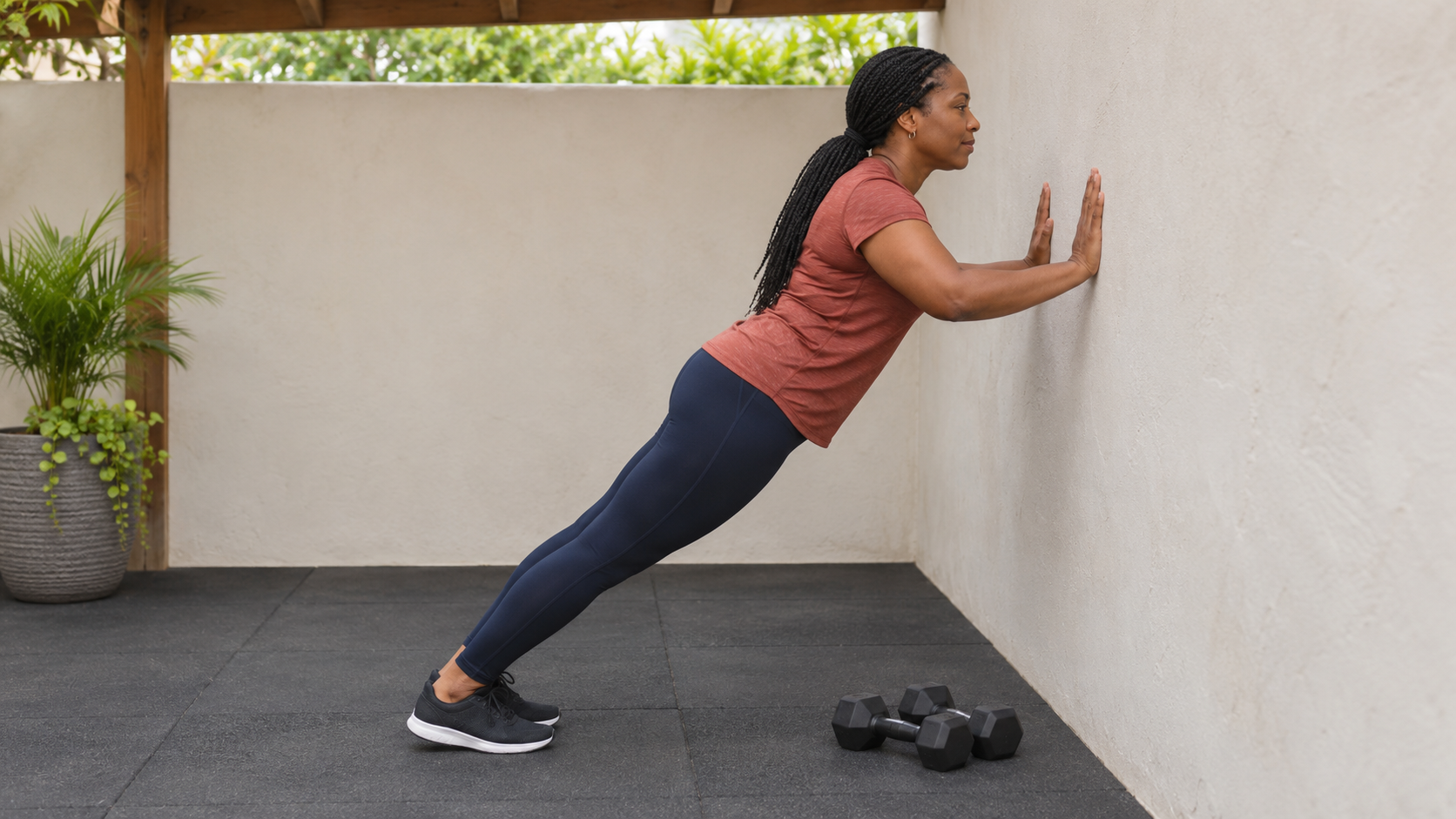
My coaching starting point is the movement, not the equipment category. A person can be comfortable with a weighted squat and still prefer a wall push-up to a floor push-up. That is a set of exercise choices, not a contradiction.
If you already have a strength routine you enjoy, keep its useful structure. This guide helps you think through the resistance options within it. It is not a new workout or a reason to replace everything that is working.
Both belong to resistance training
The American Heart Association's resistance-training summary includes bodyweight, free weights, resistance bands and machines among the available modes. The distinction is where the resistance comes from, not whether one category counts as real training.
Mayo Clinic's strength-training guide lists movements such as push-ups and squats as bodyweight options, alongside tubing, free weights and machines. Some bodyweight exercises need little equipment. Others still require suitable support or apparatus.
Bodyweight does not automatically mean easy
A floor push-up and a wall push-up use the same broad category of resistance, but they ask for different amounts of work. Similarly, the word dumbbell says little about how demanding an exercise will be without knowing the load and movement.
Use the actual variation as your unit of comparison. Avoid ranking an entire category as beginner or advanced.
The American College of Sports Medicine's 2026 position-stand summary identifies bodyweight, bands and home training as effective options. It also emphasizes a program that fits the individual and can be followed consistently. This supports having choices. It does not establish that every choice produces identical results for every goal.
Choose the resistance for one movement
Start with an exercise already in your plan. Work through these three questions before deciding whether it needs bodyweight, external resistance or another familiar variation.
1. What is the exercise meant to do?
Identify the movement your plan calls for. If you are unsure, ask the instructor what should stay the same when you substitute. Replacing a pulling exercise with a squat simply because no weights are available changes the task.
Decision: Keep the intended movement clear before choosing its tool. A substitution should have a reason beyond using whatever happens to be nearby.
2. Is the setup actually usable?
Look at the space, available equipment and any support the variation requires. A bodyweight option is convenient only if you have a suitable place to do it. A weighted option is convenient only if you can set up, hold and put away the equipment appropriately.
Decision: Choose an option with a clear movement area and stable, intended support. Do not improvise with an unsecured table, door or loose household object just to keep an exercise label.
3. Can you adjust the challenge?
Think about the next easier or harder option, not just today's choice. External weights let you change the load when suitable increments are available. Bodyweight variations can change the position or support, but the next variation may be a bigger step than you want.
Decision: Prefer the option you can adjust while preserving the intended movement and control. More complicated is not automatically more useful.
If you have already chosen dumbbells and need to choose their weight, use the separate dumbbell rep-test guide. That is the next decision, not a reason to redo this comparison.
A mixed workout is a normal option
Imagine your existing session includes a push, a squat and a row. You might use a familiar wall push-up for the push and dumbbells for the other movements. Another person might make different choices. The examples illustrate tool selection; they are not a prescribed sequence or complete workout.
| Your situation | What to consider |
|---|---|
| A familiar bodyweight variation fits the movement and space. | Keep it. Owning weights does not oblige you to use them for everything. |
| The next bodyweight variation feels like a large jump. | Ask whether an externally loaded version offers a more manageable adjustment. |
| The available weights do not offer a suitable load. | Consider another familiar variation with your coach instead of forcing the available pair. |
| You want to improve a specific exercise. | Make sure your plan actually practices that exercise. A broad category cannot replace a specific goal. |
Keep the tool choice separate from the weekly schedule. If the schedule is what you need to decide, the guide to how many days to strength train addresses that question.
Mayo Clinic recommends learning appropriate technique and adjusting resistance gradually. If you do not know how to perform a variation, get instruction before making it your workaround. Stop an exercise that causes pain and seek appropriate professional guidance.
Choose the resistance that serves the movement you intend to practice.
Keep one workable backup
A missing pair of dumbbells does not require redesigning the whole week. It does require an honest choice about what you can do with the setup you have.
Plan A: Use the familiar variation in your existing plan and record the equipment or support you used.
Plan B: Use a familiar alternative already agreed with your coach, if it fits the same intended movement. Record that it was different.
Rescue option: If you cannot identify a suitable alternative, ask before improvising. Leave that exercise unresolved rather than pretending an unrelated movement completed it.
The minimum that still counts as preparation: Write down one planned exercise, its usual setup and the question you need answered. This is a useful planning step, not a claim that you completed a workout.
If you miss the session: Return to the next planned session or discuss the schedule with your coach. Do not automatically add extra work to make up for the missed day.
Make the choice repeatable
Write down the exact variation, support and resistance. A note that only says push-ups or weights leaves out the detail you need next time. When you change the setup, mark the change rather than comparing unlike sessions as if nothing changed.
Record the variation you chose
Your next useful step is a clear workout entry. The workout-log guide shows what to record for bodyweight and weighted exercises, so you can return to the same setup and recognize when it changes.
Read the Workout Log GuideIf choosing a suitable variation is where you get stuck, live coaching can help you understand the exercise and discuss an option for the equipment you have. Try Siwicki Fitness if you want that support during your training.
Start Your Free WeekFrequently asked questions
Is bodyweight exercise resistance training?
Yes. Your muscles work against resistance supplied by your body and gravity. Bodyweight exercise is one form of resistance training, alongside options such as free weights, bands and machines.
Can bodyweight exercise build strength?
Yes, bodyweight training can improve strength. Whether a particular exercise fits your goal depends on its difficulty, how you perform it and how your training develops. That does not make every bodyweight exercise equivalent to every weighted exercise.
Should beginners use bodyweight or weights?
There is no universal starting tool. A bodyweight movement can be demanding, while a light external load can sometimes be easier to adjust. Choose a familiar variation you can perform with control, and ask a qualified trainer when the choice is unclear.
Can I combine bodyweight exercises and weights?
Yes. You can choose the tool separately for each movement in your existing plan. Keep the purpose of the exercise clear and record the variation, rather than treating a change of equipment as automatically better.