What Weight Dumbbells Should I Use? A Simple Rep Test
If you have ever stood over a pair of dumbbells wondering whether to grab the light ones or the heavy ones, you are asking the right question in the wrong way.
There is no universal dumbbell weight that fits every beginner, every body, and every exercise. The weight you can row may be different from the weight you can press. A squat may use more load than a lateral raise. Even the same exercise can need a different weight when the rep target, tempo, or range changes.
Instead of chasing one starting number, use a short rep and control test. It gives you a decision you can repeat every time a workout changes.
The Short Answer
Choose a dumbbell that lets you complete your planned reps with a stable position, full useful range, and steady control. Near the end of the set, the work should require more focus, but the exercise should still look like the exercise you started.
For a simple starter test, use a range of 8 to 12 controlled reps. That range is a testing tool, not a law. If your program gives you a different target, test the load against that target instead.
The American College of Sports Medicine free-weight guidance emphasizes controlled technique, using a manageable load, and progressing without sacrificing form. That is the standard this test follows.
Use the Simple Rep Test
1. Test one exercise at a time
Do not choose one pair of dumbbells for the whole workout before you begin. Start with the first movement. A weight that fits a goblet squat may not fit an overhead press, row, curl, or shoulder raise.
2. Pick a conservative first load
Choose a dumbbell you expect to control for the full target range. If you are between two options or unsure of the movement, start lighter. The first set is information, not a test of toughness.
3. Complete 8 to 12 clean reps
Move through a useful range without rushing. Keep your grip secure, your position stable, and the working joints moving as intended. Count only the reps that meet the same standard as the first one.
4. Check the final three reps
Ask what changed. Did you need more focus while the movement stayed controlled? Could you have completed several more clean reps? Did you start swinging, twisting, holding your breath uncontrollably, or shortening the range?
5. Adjust the next set
Go lighter when control breaks before the target. Stay with the weight when the final reps are challenging and repeatable. Go heavier only when the set stays easy and the next available weight still lets you control the movement.
Your first set does not need to prove anything. It needs to teach you what the next set should be.
Too Light, Right, or Too Heavy?
The weight is probably too light when
- You reach the top of the target range and could complete several more controlled reps.
- Your speed and effort barely change from the first rep to the last.
- The set does not require added focus near the end.
- You have already repeated the same easy result across your planned sets.
Next move: Try the smallest practical increase on the next set or next session, then run the test again.
The weight is probably right when
- You reach the planned reps without changing position or range.
- The last two or three reps require real attention.
- You could likely complete another clean rep or two, but not many more.
- You can repeat the set after normal rest without the movement falling apart.
Next move: Keep the load until the top of the range becomes consistently controlled across your sets.
The weight is too heavy for that set when
- You cannot reach the planned reps without swinging or using momentum.
- Your range shortens because the dumbbell will not move through the intended path.
- Your grip, wrist, shoulder, back, or stance loses a stable position.
- The working side changes because another body part takes over.
- You feel sharp, worsening, or unusual pain.
Next move: Stop the set, reduce the load, and rebuild the same movement with control. Pain is not part of the rep test.
Use Different Weights for Different Exercises
Your body does not have one strength setting. Larger muscle groups, stronger positions, and movements that use more joints often handle more load than small isolation exercises. Your own history, mobility, technique, and equipment matter too.
- Squats and hip hinges: These may use a heavier dumbbell because the legs and hips share the work.
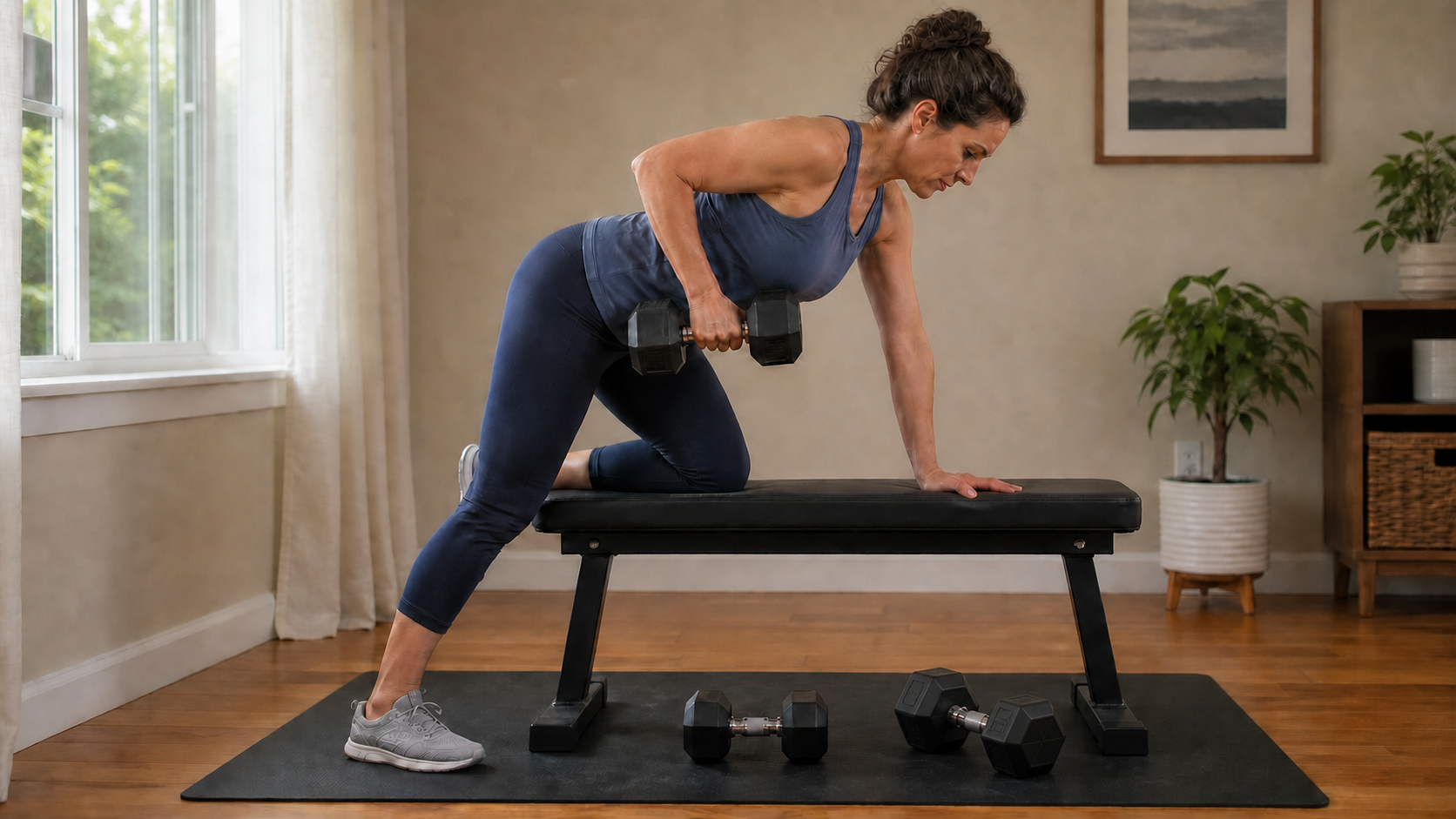
- Rows: Many people can row more than they can press, but the torso must stay stable instead of rotating to move the weight.
- Chest and overhead presses: These often need a more conservative test because shoulder position and control matter throughout the rep.
- Curls, triceps work, and shoulder raises: Smaller movements often use lighter dumbbells. A small increase can feel large.
- Single-leg or single-arm work: Balance and stability may limit the load before the target muscles do.
This is why a fixed chart based only on sex, age, or experience can mislead you. Use those details as context, then let the actual movement decide.
If you are still deciding what equipment to own, use the home workout equipment guide. If space is the bigger problem, the small-space home gym guide covers setup, storage, and a practical equipment footprint. This article starts after the dumbbells are already available.
When to Increase Dumbbell Weight
Increase the load when you can reach the top of your planned range with consistent control across the planned sets and the current weight no longer creates enough challenge near the end.
- Keep the same exercise and rep target.
- Use the smallest practical increase available.
- Expect the reps to move toward the lower end of the range.
- Retest your position, range, and control.
- Keep the heavier load only if the movement still meets the same standard.
When a workout is new, avoid changing every variable at once. Do not add weight, add reps, shorten rest, and use a harder exercise variation in the same step. Change one thing, then see what the movement tells you.
The United States Physical Activity Guidelines recommend muscle-strengthening activity for adults on two or more days each week. The useful goal is not to make every set as heavy as possible. It is to build a repeatable strength practice that can progress over time.
What If You Only Own One Pair?
You can still use the same decision process. If the dumbbells are too heavy for one movement, choose a more stable or two-arm version, reduce the range only when the variation is intentionally designed that way, or use body weight instead. Do not force poor form to make the equipment fit.
If the dumbbells are too light, add controlled reps within a useful range, slow the lowering phase, pause at the hardest point, or use one side at a time when the exercise stays safe and stable. The goal is to make the movement more demanding without turning it into a different, uncontrolled exercise.
For a complete starting plan, use the first 30 days beginner home workout guide. Then use the guide to choose two, three, or four weekly strength days and the guide to choose a realistic session length.
Turn the Right Weights Into a Real Week
The Free Stronger Week Quick Start gives you one short home strength workout, a simple weekly plan, and a backup for busy days.
Get the Free Quick StartNo credit card. No commitment. One short workout and a plan you can actually use.
Dumbbell Weight FAQ
There is no one beginner weight for every person or exercise. Start with a load you expect to control for the planned rep range, then use form, range, and the last few reps to decide whether to go lighter or heavier.
The weight may be too light when every rep stays easy, you could complete several more controlled reps, and the set does not require added focus near the end.
The weight is too heavy for that set when you cannot reach the planned reps without swinging, shortening the range, changing position, or losing a stable grip. Sharp, worsening, or unusual pain is a reason to stop.
Usually not. Larger movements and stronger muscle groups may use more load than smaller shoulder or arm exercises. Test each movement separately.
Increase when you can complete the top of your planned range with consistent control across your sets and the current load no longer provides enough challenge. Use the smallest practical increase and retest.