Strength Training Tempo: How to Read the Numbers and Use the Cue
“Three seconds down” is clear. A workout that says “3 1 1 0” can feel like a code.
Strength-training tempo describes the timing within one repetition. Learn which phase each number belongs to, then use the cue your session actually calls for.
From a coaching point of view, a tempo cue is useful when you know what action it asks for. Counting harder is not much help if you are counting the wrong part of the movement.
If you already do familiar strength exercises at home, you do not need to replace your routine to understand this. Start with one instruction in the workout you have, and make sure you and the coach mean the same thing.
Read the four numbers as four phases
In the common convention described by OPEX Fitness’s tempo guide, the numbers describe the eccentric phase, a pause, the concentric phase and another pause. For a familiar dumbbell curl, think lowering, pause, lifting, pause.
Example: 3 1 1 0
- 3: Lower the weight over three seconds.
- 1: Pause for one second after that lowering phase.
- 1: Lift over one second.
- 0: Do not add a deliberate pause before the next lowering phase.
This decodes an example. It does not mean every exercise or workout should use this pace. A zero means no added pause, not dropping the weight or bouncing through the transition.
You may also see an X in a tempo prescription. It commonly signals an intent to move explosively in that phase. It is not a number of seconds or an instruction to improvise a maximal-speed movement. Ask the coach what it means for the exercise and your session.
The first number may not be your first movement
This is the easy part to miss. The code keeps its phase order even when the exercise starts somewhere else.
A curl begun with your arm down starts by lifting. That is the third part of the code. After lifting, you follow the fourth part, then the first as you lower, then the second before lifting again.
By contrast, a squat begun from standing starts with the lowering phase, so its first movement corresponds to the first number. The exercise and starting position determine where you enter the sequence.
Ask for one complete repetition
“Can you show me where the count starts and where each pause goes?”
A demonstration is often clearer than trying to translate unfamiliar terminology while holding a weight. If a program uses a different notation, follow its explanation rather than assuming the convention is universal.
A useful tempo cue tells you what to do during the repetition.
Choose the next step by how clear the cue is
The workout gives a cue you understand
Follow that cue for the intended exercise. Keep the count steady enough to mean roughly the same thing across repetitions. If you record the session, note the cue alongside the exercise, load and repetitions.
The numbers or starting position are unclear
Ask for a demonstration before adding the unfamiliar timing. During a recording, pause and use the service’s support options. You do not need to guess your way through a complicated count.
The workout gives no tempo
Do not add a demanding slow-count prescription just because you saw one online. Use the movement instruction already provided and ask whether a specific tempo serves the session’s purpose.
If a changed pace makes your usual weight difficult to control, do not force the old rep count. Pause and ask how to adjust the exercise. The dumbbell weight guide covers the separate decision of choosing a manageable load.
A longer repetition and a heavier weight are different changes. Keep that distinction in your notes so you do not treat two different versions of a session as identical.
Slower is not automatically better
The 2026 American College of Sports Medicine position stand reviewed evidence on resistance training in healthy adults. It found that time under tension did not consistently affect training outcomes across the evidence it examined.
That finding does not establish one perfect tempo, and it does not mean speed is irrelevant to every goal. It is a reason to be cautious about blanket promises that simply making every repetition slower will produce better results.
For the decision here, treat tempo as part of an instruction you want to understand. You can clarify the cue and make your notes more comparable without claiming a special muscle-building shortcut.
Keep the task small when training at home
Minimum useful step: Understand the phases of one familiar exercise and write down its cue. This is a learning step, not a replacement for the workout.
Plan A: Clarify the cue before your planned session and use it as instructed.
Plan B: If the explanation is unavailable, use a familiar option already approved in your program rather than inventing a new tempo challenge.
Rescue option: Stop the confusing set, note your question and ask before the next attempt. Counting should not take priority over control.
Missed-day rule: Return at the next suitable session. Missing a day does not require extra repetitions or extra-slow sets to make up for it.
Put the cue somewhere you can use it
The next useful step is a short note: the exercise, its tempo cue and anything you need clarified. The workout-log guide shows how to keep those details easy to compare.
If you would like an instructor available to explain a cue during a live class, Siwicki Fitness offers live coaching alongside on-demand workouts. A Free Week lets you try that support in your own routine.
Start Your Free WeekStrength-training tempo questions
What does 3 1 1 0 tempo mean?
In the common four-part convention, it means three seconds for the lowering or lengthening phase, a one-second pause, one second for the lifting or shortening phase, and no deliberate pause before the next lowering phase. Confirm how the coach applies those phases to your exercise. This is an example of notation, not a prescription for every exercise.
Are slower repetitions always better?
No. The 2026 American College of Sports Medicine overview of reviews in healthy adults found that time under tension did not consistently change training outcomes. That does not make movement speed irrelevant to every goal. Follow the purpose of the session rather than assuming a longer repetition is automatically better.
Why does a biceps curl start on the third tempo number?
A curl that begins with your arm down starts with the lifting phase. In the common notation, lifting is the third number even though it is the first movement you perform. The code follows a fixed phase order, not necessarily your starting position.
Do I need a metronome to use tempo?
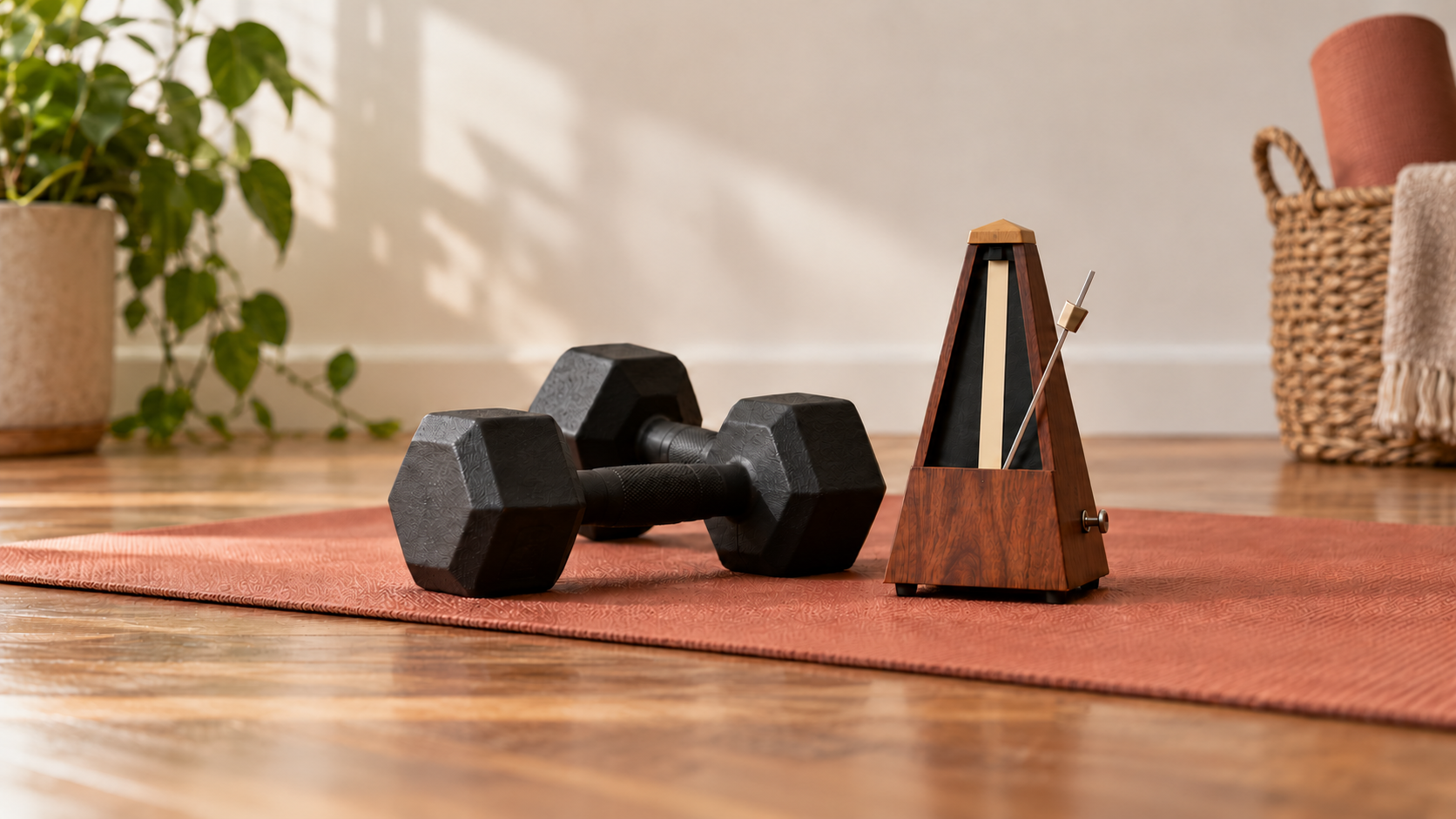
No. A coach’s spoken count or your own steady count can help you understand a cue. The metronome in the image is an illustration of rhythm, not required equipment. If counting distracts you from the movement, ask the coach for a simpler cue.